
© Collection of the Research Center for Historical Visual Media, University of Würzburg
Energy and energy supply are key areas in the context of sustainability policy, both nationally and globally. The topic is also present in school lessons. Future-oriented energy use is part of school curricula, and students learn about the forms, potential, and problems of energy production as part of education for sustainable development (ESD). In the Agenda 2030 program, the area of “affordable and clean energy” represents a Sustainable Development Goal of the global community for social, economic, and sustainable development and is thus part of the overall creation of sustainable structures.
It is not only advisable to focus on sustainable learning goals and “sustainability skills” for overcoming future challenges, but also to understand how “reliable and modern energy,” which today stands for renewable energy and energy efficiency, has changed over the decades. While ESD education programs primarily focus on current developments, an analysis of historical sources can lead to an interesting broadening of perspective. In particular, the analysis of school wall charts, as historically relevant teaching media, shows how the topic of energy supply was dealt with in schools at the end of the 19th century and throughout the 20th century. They highlight the connection between pedagogical and didactic use, economic relevance, and energy policy significance. This is because energy resources were not only visualized and discussed, but also institutionally legitimized.
This was true for coal for a long time.
With its high energy content, coal was the driving force behind German industry for decades. That is why publishers of school wall charts also took up the topic of coal. In 1894, for example, the publisher F. E. Wachsmuth (Leipzig) published the school wall chart “Coal Mine.” The picture was created in the context of increased energy consumption at the turn of the century. Hard coal production in Prussia rose to a peak of 114 million tons by 1910. Interestingly, global thinking was already taking place regarding the sustainable use and reserves of this fossil fuel. Looking to the future, it was said: „There is no reason to believe that coal reserves will be exhausted in the foreseeable future. It is assumed that around 13 cubic kilometers of coal will have been mined by 1900, and the world’s coal reserves are estimated at approximately 80 cubic kilometers. England and Germany can still meet their needs for centuries to come, and then Russia and numerous other countries with their untapped coal deposits will offer ample replacement.“ (Eschner, 1902, p. 19).
However, it is not only hard coal consumption that is increasing, but also the use of lignite.
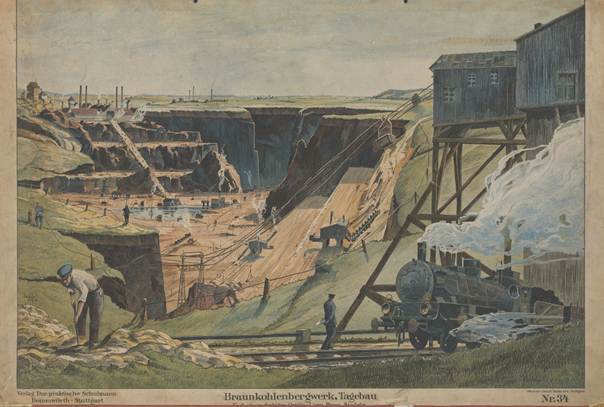
“The German lignite industry […] forms one of the most important foundations for our entire German economy,” notes the school wall chart “Lignite Mine, Open-Cast Mining,” which is published in 1926. The chart owes its creation to the lignite boom that began in the second half of the 19th century. Due to the growing demand for energy and electricity in the context of industrialization, lignite became increasingly important in all mining regions. At the beginning of the 20th century, there was an increase in the construction of large open-cast mines, as the school wall chart indicates.
The accompanying educational text describes and justifies the advantages of opencast mining over underground mining. The individual stages of lignite extraction are summarized and listed in the text. At the end, however, alongside the reference “No country in Europe is as rich in lignite as Germany” (Behrens, 1926, p. 14), there are also words of warning: „According to official estimates, there are around 14 million tons in the [German] soil, which, based on current consumption, would be exhausted in around 80 years. That is why it is important not to overexploit the resources and to economize, whether through technical improvements to the extraction facilities […] or through further utilization of the material itself, for which opportunities will certainly arise“ (ibid.).
During the Nazi era, coal was not only a source of energy for industry and households, but also a particular focus in terms of fuel production. This was due to the National Socialist policy of self-sufficiency. School wall charts also showed coal hydrogenation. The fact that coal hydrogenation in chemical plants such as Leuna was very energy-intensive and polluting was not addressed.
The theme of energy resources continued to be addressed in school wall charts until the beginning of the 21st century. A school poster from 2002 “advertises” renewable energies. The change in energy forms from coal to oil, gas, nuclear power, and solar and wind energy, among others, is reflected in the respective depictions on school wall charts.
School wall charts thus also provide an exciting glimpse into the history of energy production.